 Atlantic
Atlantic
Factory investigates the backlog, writes the change, proves it in a browser, reviews the diff, and opens the pull request.
Claude Code runs in your terminal and does what you ask. Atlantic owns the pipeline end to end and shows its receipts.
Updated August 2026
AtlanticFactory investigates the backlog, writes the change, proves it in a browser, reviews the diff, and opens the pull request.
 Claude Code
Claude Code works from your terminal and follows the task you give it. Your team remains responsible for selecting, proving, and reviewing the work.
The difference is not who can write code. It is who chooses the work, proves the result, and owns the path to review.
| Feature | Atlantic | Claude Code |
|---|---|---|
| Picks the problem from your backlog | Yes, three finders and a judge | No, you ask it |
| Browser QA on a booted preview | Every run, up to 40 steps on video | No |
| Second-model review before the PR | Yes, up to 2 fix cycles | No |
| Opens a pull request, never merges | Yes, human merge always | You commit yourself |
| Pay only when a PR lands | Yes, nothing-to-do costs nothing | No, per-usage subscription |
AtlanticYes, three finders and a judge
Claude CodeNo, you ask it
AtlanticEvery run, up to 40 steps on video
Claude CodeNo
AtlanticYes, up to 2 fix cycles
Claude CodeNo
AtlanticYes, human merge always
Claude CodeYou commit yourself
AtlanticYes, nothing-to-do costs nothing
Claude CodeNo, per-usage subscription
Factory boots the branch on a real machine, drives the changed surface in a browser, and records the result before the pull request opens.
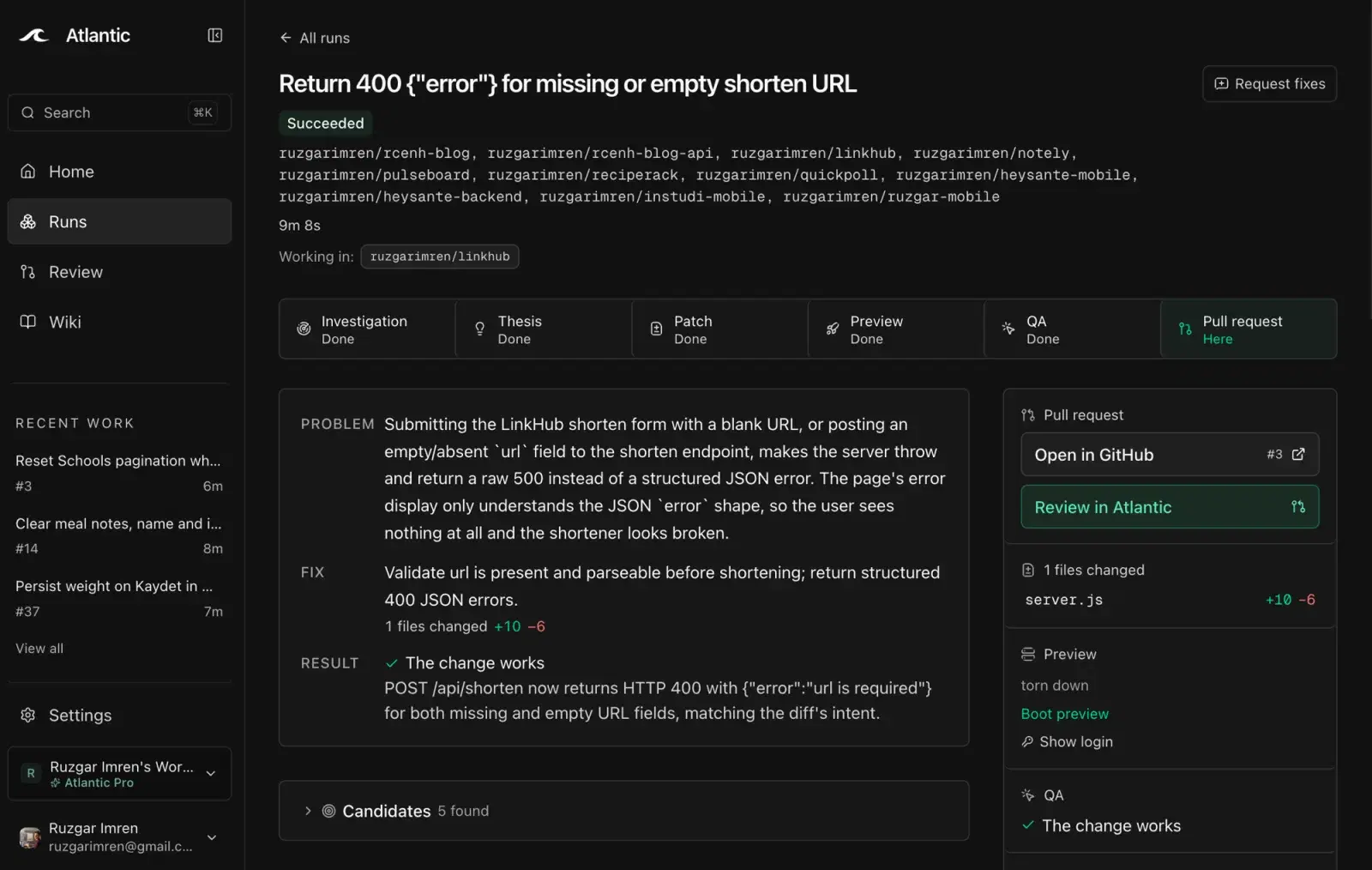
Linear, Jira, GitHub, Slack, Sentry, and your repository give Factory the context to choose and scope the next issue.
See integrations Linear
 GitHub
 Jira
Jira Slack
Slack Sentry
 Notion
A separate model reviews the diff, raises blockers and flags, and sends fixes back through the loop. Factory never merges the result.
Atlantic investigates, implements, proves, and reviews the change. Your team makes the final call.